 ultimate-guide
Essential Kitchen Tools for First Apartment: A 2026 Guide
Table of Contents
- What Essential Kitchen Tools You Actually Need
- Chef's Knife and Cutting Board Basics
- Cookware That Works in Compact Spaces
- Must-Have Kitchen Utensils and Small Appliances
- Space-Saving Kitchen Gadgets for Renters
- Kitchen Safety Checklist for First-Time Renters
- Choosing the Best Kitchen Starter Set
- Durability, Maintenance, and Long-Term Value
- Frequently Asked Questions
Last Updated: September 2, 2026
What Essential Kitchen Tools You Actually Need
Setting up your first apartment kitchen doesn't mean buying everything you see. The truth is, most people accumulate twice as much as they actually use.
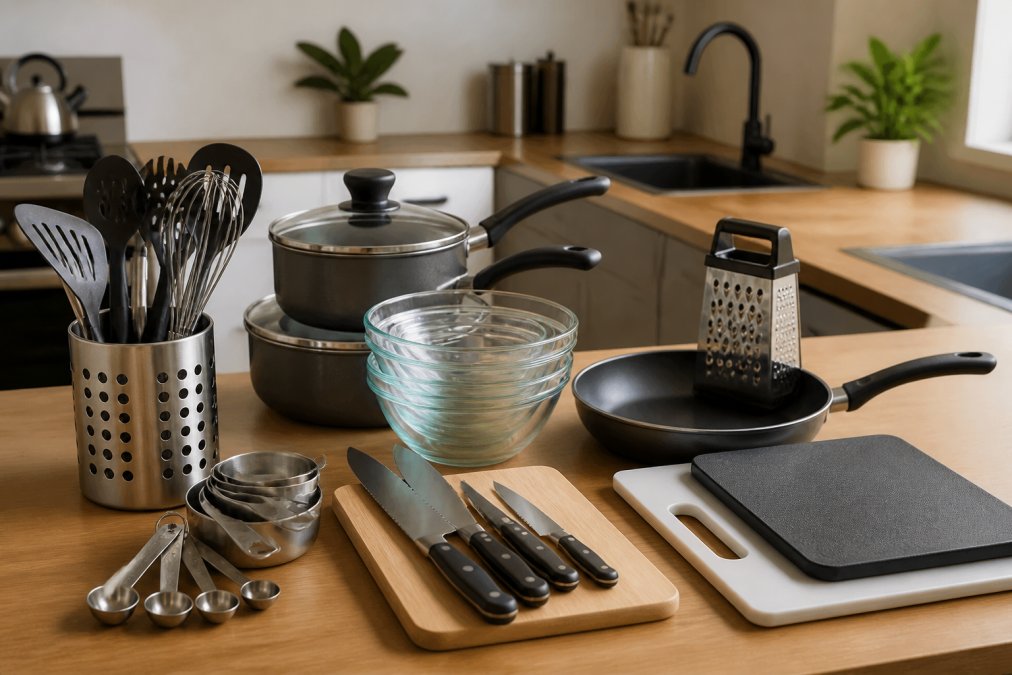
You need tools that work hard in compact spaces and earn their place on your counter or in your cabinet. A chef's knife, cutting board, non-stick skillet, and a few utensils will handle 90% of what you cook. Beyond those basics, the question isn't "what else exists?", it's "what will I actually reach for?"

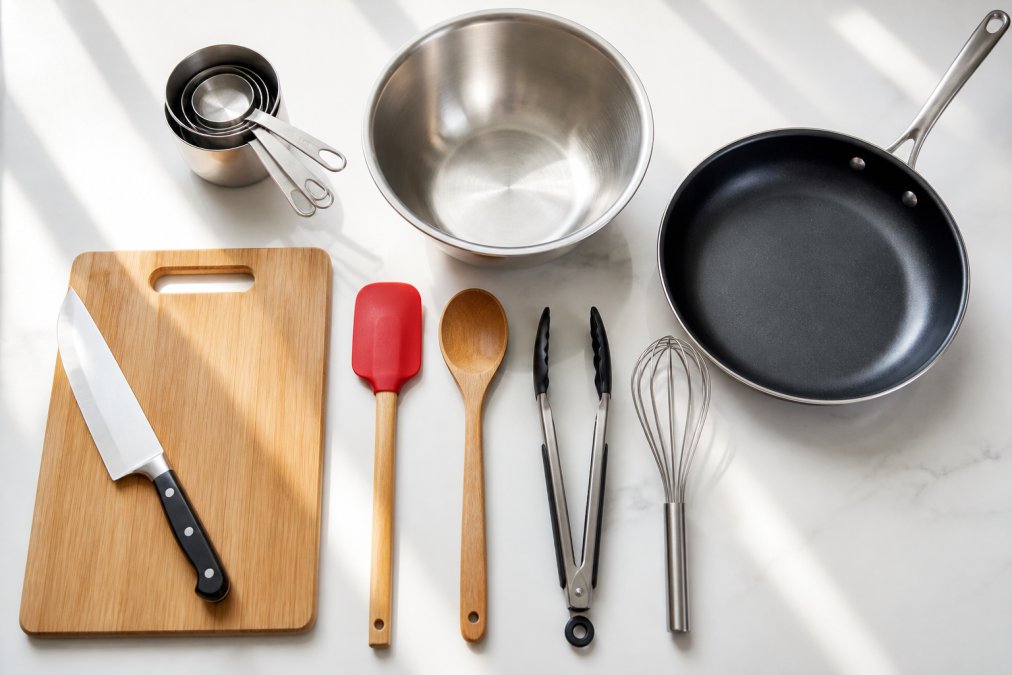
The mistake renters make is thinking they need professional-grade equipment. You don't. What you need are tools that survive regular use, work on any stovetop, and fit in limited storage. A quality non-stick skillet outperforms a cheap stainless steel one every single time. A sharp chef's knife makes prep work faster and safer than struggling with a dull blade. Good measuring cups prevent baking disasters that waste money and ingredients.
Build your kitchen intentionally. Start with the items that appear in nearly every recipe, then add tools as you discover what you actually cook. This approach saves money and keeps your space uncluttered.
Chef's Knife and Cutting Board Basics
A sharp chef's knife is the single most important tool in any kitchen. It's the one investment that changes how you cook immediately. A dull knife is dangerous, you apply more pressure, your hand slips, and accidents happen. A sharp knife glides through vegetables and proteins with minimal effort.
For a first apartment, an 8-inch chef's knife handles 95% of your cutting tasks. It's large enough for efficiency but not so massive that it feels awkward in your hand. Pair it with a quality cutting board that won't slide around your counter and won't dull your blade.

The 16 Pieces Kitchen Knife Block Set with Cutting Board from Counter and the Cook ($41.12) gives you exactly what you need without excess. It includes an 8-inch chef's knife, bone knife, bread knife, santoku, utility knife, paring knife, steak knives, kitchen shears, and a built-in sharpener. The German stainless steel holds an edge well, and the included sharpener means you can maintain your blades without buying separate equipment.
The set comes with a cutting board, which solves a common problem: finding a board that won't damage your knives and won't slide off the counter. Look for boards with juice grooves to catch liquid and slip-resistant bases. The BPA-Free Reversible Kitchen Cutting Board Set of 3 ($41.85) from Counter and the Cook offers three sizes (16" x 11.2", 13.8" x 9.6", and 11.8" x 8") so you have options for different tasks. The nonporous surface won't absorb odors or harbor bacteria like wood boards, and they're dishwasher safe.
Cookware That Works in Compact Spaces
Non-stick cookware is non-negotiable for apartment living. It heats quickly, requires less oil, and cleans in seconds. Stainless steel sounds professional, but it demands constant attention and takes longer to heat. For your first kitchen, non-stick wins every time.
The critical feature for renters is stackability. A 9-piece non-stick cookware set with detachable handles solves the storage problem that kills most apartment kitchens. The Pots and Pans Set with Detachable Handle ($76.06) from Counter and the Cook lets you remove handles and nest the pans, saving up to 70% of cabinet space. The cookware is made from recyclable aluminum, PFAS-free, and works on all stovetops including induction.

What makes this set different from cheaper alternatives is the build quality. The non-stick surface actually lasts. Thin, flimsy pans develop hot spots and the coating peels after a few months. This set has a thickened flat base for even heating and a durable non-stick finish that resists scratching.
Start with this one set. You'll use the 8-inch and 10-inch skillets constantly. The sauce pot handles pasta water and soups. The stockpot is for larger quantities. The griddle works for pancakes, grilled cheese, or seared vegetables. Everything is dishwasher safe, which matters when you're tired and want to go to bed instead of hand-washing.
Must-Have Kitchen Utensils and Small Appliances
Beyond pots and pans, you need the tools that make cooking faster and easier. A silicone utensil set eliminates the guessing game. The Silicone Cooking Utensils Set ($50.65) from Counter and the Cook includes a spatula, spoon, whisk, tongs, pasta fork, and more, all heat-resistant to 600°F and safe for non-stick cookware. Food-grade silicone won't leach chemicals, won't retain odors, and cleans in seconds. Each utensil has a stainless steel core for durability.
Measuring cups and spoons prevent recipe failures. The 10-Piece Stackable Measuring Set ($17.42) from Counter and the Cook nests together for storage and includes all the sizes you need: 1/8 cup through 1 cup, and 1/4 teaspoon through 1 tablespoon. Stainless steel won't rust, and the engraved markings stay legible.
For small appliances, a toaster and coffee maker are the practical choices. The 2-Slice Toaster ($49.78) from Counter and the Cook has 1.5-inch extra-wide slots for thick bread, bagels, and waffles. Six browning settings let you dial in your preference, and the removable crumb tray keeps your counter clean. If you drink coffee, the K-Mini Single Serve Coffee Maker ($124.01) is less than five inches wide, it actually fits in a small apartment. Brew any cup size between 6-12 ounces, and the auto-off feature saves energy.
| Utensil | Purpose | Frequency of Use |
|---|---|---|
| Chef's Knife | Chopping vegetables, proteins, herbs | Daily |
| Cutting Board | Prep surface | Daily |
| Non-stick Skillet | Sautéing, pan-frying | 4-5 times per week |
| Spatula | Flipping, scraping | Daily |
| Whisk | Mixing batters, eggs, dressings | 2-3 times per week |
| Measuring Cups | Baking, precise cooking | 3-4 times per week |
| Tongs | Gripping, turning food | 3-4 times per week |
Space-Saving Kitchen Gadgets for Renters
Your apartment kitchen has limits. Every tool must earn its space. Multi-functional items beat single-purpose gadgets every time. A mixing bowl set that doubles as storage, a dish rack that fits over your sink, and food containers that organize your pantry, these solve real problems.
The 26-Piece Stainless Steel Mixing Bowl Set ($61.40) from Counter and the Cook includes six nested bowls with airtight lids and three grater attachments. Use the bowls for mixing, serving, and storage. The lids mean you can prep ingredients in advance and stack them in your fridge. The graters handle shredding cheese and vegetables without buying a separate tool.
Food storage transforms a chaotic pantry into an organized system. The 48-Piece BPA-Free Food Storage Set ($37.41) from Counter and the Cook includes 24 containers in eight different sizes with airtight lids and labels. Stackable design means they actually fit in your cabinets. Leak-proof seals protect against spills and keep pests out. Use them for pantry staples, leftovers, and meal prep.
The Over the Sink Dish Drying Rack ($29.15) from Counter and the Cook solves the counter-space problem. It sits over your sink and rolls up for storage when not in use. Stainless steel frame with food-safe silicone won't rust or warp. At 17.5" x 11.8", it fits most apartment sinks. Use it for drying dishes, cooling hot pans, or even as a prep surface.
Kitchen Safety Checklist for First-Time Renters
Safety in the kitchen prevents injuries and fires. As a renter, you have specific constraints, you can't install permanent fixtures, and your landlord probably won't approve major modifications. Work within those limits.
Start with fire safety. Keep a small fire extinguisher under your sink. Know where your circuit breaker is. Never leave cooking food unattended. Use oven mitts, not a towel, to handle hot cookware. The heat-resistant silicone utensils mentioned above protect your hands from burns.
Keep knives sharp. A dull knife requires more pressure, which means your hand is more likely to slip. Store knives in a block or with blade guards, never loose in a drawer. Cut away from your body, and keep your fingers curled when holding food.
Food safety matters more in a small kitchen where storage is limited. Keep raw meat and produce separated. Clean cutting boards immediately after use, especially after cutting raw chicken. Wash your hands before and after handling raw proteins. Don't leave cooked food sitting at room temperature for more than two hours.
Your non-stick cookware should never exceed medium-high heat. Overheating damages the coating and can release fumes. Use wooden or silicone utensils, never metal, which scratches the surface. Hand-wash non-stick pans when possible, though the cookware sets mentioned are dishwasher safe.
Check that your apartment has working smoke detectors. Test them monthly. If your landlord hasn't installed them, request it in writing. Most jurisdictions require working detectors in rental units.
Choosing the Best Kitchen Starter Set
A starter set should give you everything you need without forcing you to buy items you'll never use. The best approach is buying individual quality pieces rather than a bundled set that includes things you don't need.
However, if you want one comprehensive solution, the Counter and the Cook knife set with cutting board ($41.12) is the strongest starting point. It gives you cutting tools, storage, and a sharpener. Add the non-stick cookware set ($76.06) and the silicone utensil set ($50.65), and you're at roughly $168, enough to cook almost any meal.
From there, add based on what you actually cook. If you bake, get measuring cups ($17.42). If you meal prep, get the food storage containers ($37.41). If you entertain, get the mixing bowl set ($61.40). If you need counter space back, get the dish rack ($29.15).
This modular approach beats buying a pre-packaged "starter kit" because you're not paying for items you'll never use. You're building a kitchen that matches your actual cooking habits.
Durability, Maintenance, and Long-Term Value
Quality tools cost more upfront but save money over time. A $40 non-stick skillet that peels after six months costs more than a $76 set that lasts five years. Do the math: $40 per year versus $15 per year.
German stainless steel knives hold their edge longer than cheaper alternatives. The hardness rating (HRC 48-53) matters, it determines how long the blade stays sharp and how well it resists chipping. Silicone utensils with stainless steel cores outlast all-plastic alternatives because the core prevents warping and deformation.
Non-stick cookware requires specific care to last. Never use metal utensils. Hand-wash when possible. Don't preheat an empty pan, add oil or food first. These habits extend the life of your cookware from two years to five years or more.
Cutting boards need attention too. Wash immediately after use, especially after cutting raw meat. Dry them standing upright, not stacked flat. Nonporous boards like the Counter and the Cook cutting boards resist bacteria growth better than wood, which absorbs liquids and harbors pathogens.
Food storage containers crack when you stack them too tightly or force lids on when the container is misaligned. Take two seconds to seat the lid properly. Hand-wash lids rather than running them through the dishwasher, heat can warp them. Replace containers when cracks appear; they won't seal properly and your food won't stay fresh.
Mixing bowls with non-slip bottoms prevent accidents. The rubber base protects your countertop from heat and prevents the bowl from sliding when you're whisking vigorously. Dry the rubber after washing to prevent mildew.
The knife sharpener included in the Counter and the Cook knife set keeps your blades sharp without buying a separate tool or paying for professional sharpening. A sharp knife is safer and makes cooking faster. Sharpen every month if you cook regularly.
Your first apartment kitchen doesn't need to be fancy. It needs to be functional, durable, and space-efficient. Start with the essential kitchen tools that handle 90% of your cooking: a sharp chef's knife, a non-stick skillet, quality measuring cups, and basic utensils. Add tools as you discover what you actually cook.
Counter and the Cook offers everything you need to build a kitchen that works. The knife set with sharpener, non-stick cookware with detachable handles, silicone utensils, and food storage containers are designed specifically for apartments where space matters. These tools are built to last, easy to clean, and genuinely useful. Get started with what you need now, and expand intentionally as your cooking evolves.
Frequently Asked Questions
Q: What are the essential kitchen tools for a beginner?
A: Start with a chef's knife, cutting board, non-stick skillet, sauce pot, measuring cups and spoons, spatula, tongs, and a whisk. These cover 90% of everyday cooking tasks. Add a colander, peeler, and can opener as you cook more. A quality knife block set like the 16-piece German stainless steel option consolidates knives, sharpener, and cutting board into one purchase, eliminating guesswork for new cooks.
Q: What space-saving kitchen gadgets work best for small apartments?
A: Prioritize multi-functional tools: a detachable-handle cookware set saves 70% of storage space, nesting measuring cups and mixing bowls stack compactly, and an over-the-sink dish drying rack eliminates the need for counter space. Silicone utensils with stainless steel cores take up minimal room. A single-serve coffee maker (less than 5 inches wide) and compact toaster fit tight countertops. Food storage containers with stackable design maximize pantry organization without sprawl.
Q: How do I choose durable kitchen tools on a budget?
A: Look for German stainless steel construction, which resists rust and maintains edge retention. Avoid tools with gaps where food can trap; seamless silicone utensils last longer and clean easier. Check for dishwasher-safe ratings to reduce hand-washing wear. Buy a starter set rather than individual items, the 16-piece knife block at $41.12 includes a sharpener and board, costing less than buying separately. Prioritize the three items you'll use daily: knife, pan, and utensils.
Q: What safety items do I need in my first apartment kitchen?
A: Keep heat-resistant oven mitts rated to at least 400°F, a fire extinguisher near the stove, and non-slip cutting boards to prevent accidents during prep work. Ensure all cookware has ergonomic handles for secure grip. Use food-safe, BPA-free containers to prevent chemical leaching. Check that small appliances have auto-shutoff features. Store knives in a block or magnetic strip, never loose in drawers. Keep cleaning supplies separate from food storage to prevent cross-contamination.
Q: What makes a kitchen starter set worth buying instead of individual items?
A: A complete starter set ensures you have coordinated, tested tools that work together and fit your storage space. Sets like the 16-piece knife block ($41.12) or 9-piece non-stick cookware set ($76.06) bundle items you'd buy separately at higher total cost. Starter sets are designed for beginners, so you skip tools you don't need. They often include bonus items like sharpeners or grater attachments, adding value and reducing decision fatigue when setting up your first kitchen.
Q: How do I maintain kitchen tools so they last longer?
A: Wash stainless steel immediately after use and dry with a cloth to prevent water spots and corrosion. Hand-wash silicone utensils if they have stainless steel cores to preserve the bond. Sharpen chef's knives regularly using the included sharpener in a knife set to maintain edge retention and prevent chipping. Store cutting boards upright to allow air circulation and prevent warping. Keep non-stick cookware away from metal utensils and abrasive scrubbers. Avoid extreme temperature changes that cause warping.
Q: Can I buy quality kitchen tools second-hand for my first apartment?
A: Second-hand tools can work if you inspect them carefully for rust, warping, or damage. Avoid used non-stick pans with peeling coating, as the damage is permanent and unsafe. Stainless steel knives and cutting boards age well if properly maintained. Check glass containers for chips that can break during use. New starter sets offer warranty protection and guaranteed durability, which matters when you're building a kitchen from zero. For budget-conscious renters, buying a new starter set often costs less than sourcing quality used items individually.
This article was written using GrandRanker
Frequently Asked Questions
Q: What are the essential kitchen tools for a beginner?
A: Start with a chef's knife, cutting board, non-stick skillet, sauce pot, measuring cups and spoons, spatula, tongs, and a whisk. These cover 90% of everyday cooking tasks. Add a colander, peeler, and can opener as you cook more. A quality knife block set like the 16-piece German stainless steel option consolidates knives, sharpener, and cutting board into one purchase, eliminating guesswork for new cooks.
Q: What space-saving kitchen gadgets work best for small apartments?
A: Prioritize multi-functional tools: a detachable-handle cookware set saves 70% of storage space, nesting measuring cups and mixing bowls stack compactly, and an over-the-sink dish drying rack eliminates the need for counter space. Silicone utensils with stainless steel cores take up minimal room. A single-serve coffee maker (less than 5 inches wide) and compact toaster fit tight countertops. Food storage containers with stackable design maximize pantry organization without sprawl.
Q: How do I choose durable kitchen tools on a budget?
A: Look for German stainless steel construction, which resists rust and maintains edge retention. Avoid tools with gaps where food can trap; seamless silicone utensils last longer and clean easier. Check for dishwasher-safe ratings to reduce hand-washing wear. Buy a starter set rather than individual items—the 16-piece knife block at $41.12 includes a sharpener and board, costing less than buying separately. Prioritize the three items you'll use daily: knife, pan, and utensils.
Q: What safety items do I need in my first apartment kitchen?
A: Keep heat-resistant oven mitts rated to at least 400°F, a fire extinguisher near the stove, and non-slip cutting boards to prevent accidents during prep work. Ensure all cookware has ergonomic handles for secure grip. Use food-safe, BPA-free containers to prevent chemical leaching. Check that small appliances have auto-shutoff features. Store knives in a block or magnetic strip, never loose in drawers. Keep cleaning supplies separate from food storage to prevent cross-contamination.
Q: What makes a kitchen starter set worth buying instead of individual items?
A: A complete starter set ensures you have coordinated, tested tools that work together and fit your storage space. Sets like the 16-piece knife block ($41.12) or 9-piece non-stick cookware set ($76.06) bundle items you'd buy separately at higher total cost. Starter sets are designed for beginners, so you skip tools you don't need. They often include bonus items like sharpeners or grater attachments, adding value and reducing decision fatigue when setting up your first kitchen.
Q: How do I maintain kitchen tools so they last longer?
A: Wash stainless steel immediately after use and dry with a cloth to prevent water spots and corrosion. Hand-wash silicone utensils if they have stainless steel cores to preserve the bond. Sharpen chef's knives regularly using the included sharpener in a knife set to maintain edge retention and prevent chipping. Store cutting boards upright to allow air circulation and prevent warping. Keep non-stick cookware away from metal utensils and abrasive scrubbers. Avoid extreme temperature changes that cause warping.
Q: Can I buy quality kitchen tools second-hand for my first apartment?
A: Second-hand tools can work if you inspect them carefully for rust, warping, or damage. Avoid used non-stick pans with peeling coating, as the damage is permanent and unsafe. Stainless steel knives and cutting boards age well if properly maintained. Check glass containers for chips that can break during use. New starter sets offer warranty protection and guaranteed durability, which matters when you're building a kitchen from zero. For budget-conscious renters, buying a new starter set often costs less than sourcing quality used items individually.